
Bhutan Tour
Bhutan Tour
Duration: 12 Nights / 13 Days
Places Covered: Delhi - Paro - Thimphu - Punakha - Wangdiphodrang - Gangtey - Tongsa - Bhumthang - Mongar - Tashigang - Samdrup Jongkhar - Guwahati
 Day
1: Delhi - Paro flight 1115/1500 hours
Day
1: Delhi - Paro flight 1115/1500 hours
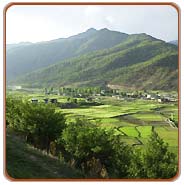
Assistance and transfer to Druk Hotel or similar. Afternoon at leisure.
Day 2: Paro
After breakfast, drive to Drukgyel Dzong, a ruined fortress where Bhutanese
warriors fought Tibetan invaders centuries ago. The snowy dome of sacred Chomolhari,
"mountain of goddess" looms directly over the dzong. Along the way,
see the 7th century Kyichu Lhakhang, one of the 108 temples built by Tibetan
King Songtsen Gampo. After lunch visit Ta Dzong, originally built as watch tower,
now houses National Museum of the Kingdom. It boasts antique thankhas, textile,
weapons and armory, household objects and a rich assortment of natural and historic
artifacts. Then walk down the train to visit Rinpung Dzong, meaning 'fortress
of the heap of jewels" which has a long and fascinating history. Along
the wooden galleries lining the courtyard of the Rinpung Dzong are fine wall
paintings.
Day 3: Paro - Thimphu drive - 54 km/2 hours
After breakfast, drive to Thimphu, the capital town passing via idyllic countryside,
through villages and paddy fields, Enroute visit the Simtokha Dzong, the oldest
fortress of the country now houses the School for Bhutan studies.
 Afternoon
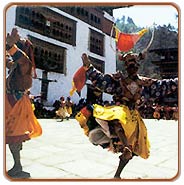
sight-seeing of Thimphu valley, visiting Taschihhodzong; the seat of the Government,
Memorial Chorten, the Stupa built in the memory of Bhutan's third King and Handicrafts
Emporium displaying rich traditional crafts of the Kingdom.
Afternoon
sight-seeing of Thimphu valley, visiting Taschihhodzong; the seat of the Government,
Memorial Chorten, the Stupa built in the memory of Bhutan's third King and Handicrafts
Emporium displaying rich traditional crafts of the Kingdom.
Day 4: Thimphu - Punakha
Morning, in Thimphu visit to National Library which has fascinating collection
of ancient Buddhist manuscripts and texts, the Painting School: famous for traditional
thankhas paintings and traditional Medicine Institute where centuries old healing
arts still practiced. .
Then proceed to Punakha across Dochula pass (3050 M) which provides a superb
view of the highest peaks of Bhutan, such as Gangkar, Puensum, table Mountain,
Masakhang etc. On arrival check-in at the hotel. .
After lunch visit Punakha Dzong. Punakha until 1955, served as the capital town
of Bhutan and still it is the winter seat of Je Khenpo, the Chief Abbot. Punakha
Dzong built by Shabdrung Ngawang, Namgyal in 17th century and situated at the
junction of Pho Chu and Mo Chu rivers.
Day 5: Punakha - Wangdiphodrang - Gangtey, 146
km
After breakfast drive to Wangdiphodrang, 17 km to visit Dzong which is pierced
on a spur at the confluence of the Sunkosh and Tangmachu rivers. 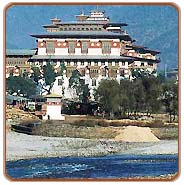 The
dzong was built in 1638. The position of the Dzong is remarkable as it completely
covers the south and east-west. Wangdi district is famous for its bamboo work,
slate and stone carving. .
The
dzong was built in 1638. The position of the Dzong is remarkable as it completely
covers the south and east-west. Wangdi district is famous for its bamboo work,
slate and stone carving. .
After lunch at Wangdiphodrang, drive for 3 hours to arrive at one of the most
beautiful open valleys in Bhutan - Gangtey. Gangtey is the winter heaven to
the rare Black Necked Crane, migrating down from the Tibetan Plateau. On a hillock
overlooking the small villages is the Gangtey Monastery. This is the only Nyingmapa
temple in the country. Overnight at the Lodge.
Day 6: Gangtey - Tongsa, 65 km
Five hours drive upwards to the Pele La Pass, crossing over the Black Mountains
which divide western and central Bhutan Pass through rich rhododendron and Yak
settlements. Cross the Nikarchu bridge to enter the Tongsa regions in Central
Bhutan. A great white stupa built in Nepalese design from 18th century stands
below the road. .
The approach to Tongsa is through the winding roads which make journey quite
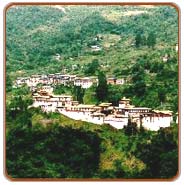
time consuming. Lunch stop at Tongsa. Tongsa Dzong at an altitude of 2200 M
is the most impressive of the Dzongs in Bhutan. Built in 1647 by the Shabdrung,
the dzong is a mater piece in architecture.
 Day
7: Tongsa - Bhumthang, 68 km
Day
7: Tongsa - Bhumthang, 68 km
In the morning visit the outer premises of Tongsa Dzong.
After lunch, 2-3 hours drive to Jakar (Bhumthang) across the Yontola Pass at
3404 m.
Arrive Jakar (Bhumthang). Overnight at the Lodge.
Day 8: Bhumtang
This is one of the most spectacular valleys in Bhutan and also the heartland
of Buddhism. Here the great teachers meditated and left in their walk many sacred
grounds. The Guru and his lineage of Tertons, teasure finders, have led to the
sprouting of many temples in the valley. Visit the famous Kurjey, Jamby and
Tamshing Lkhakhangs. Also the Jakar Dzong, seat of the distt. administration.
Day 9: Bhumthang - Mongar, 198 km/7 hours
The journey continues eastwards, winding through more rugged terrain. The drive
with spectacular views, will take about 6 hours. Pass through Ura village before
climbing sharply to the highest motor road pass in the Kingdom, the Thrushingla
Pass - 12465 ft. Gradually descend to Sengor watching cascading waterfalls along
the way. The descend stops on a bridge over the Kurichu before climb begins
again through pine forests, maize fields and eastern hamlets to Mongar town.
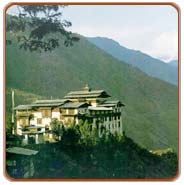
The Mongar Dzong, albeit built not too long ago, still maintains the architectural
traditions of the old dzongs.
Day 10: Mongar - Tashigang, 91 km
Drive across Korila Pass (2298 m) to Tashigang. Korila Pass is marked by a pretty
chorten and a stone wall. The drive from here takes down through Nhatsang and
Yadi villages. After Yadi a gorgeous view of the 18 beds can be seen till arrival
at Manas Chu, the biggest river in Bhutan. Overnight at Tashigang.
Day 11: Tashigang
Morning excursion to Tashi Yangtse with packed lunch. Visit Chorten Kora and
Gom Kora, built in the 17th century by Minjur Tempa. It is believed that Guru
Padmasambhava meditated at the site of the temple in the 8th century to subdue
a demon who dwelt in the rock. This little temple contains the statues of Guru
Padmasambhava and Avalokiteshvara.
Day 12: Tashigang - Samdrup Jongkhar, 180 km
6 to 7 hours drive in the south to the small frontier town of Samdrup Jongkhar.
Along the way see Sherubuste, the only college in the country, the blid school
and the weaving centre in Khaling.. The drive is on up/down road.
Day 13: Samdrup Jongkhar - Guwahati, 110 km
Drive to Guwahati in India for onward programme.