
Tiger Trail Ranthambhore
Tiger Trail Ranthambhore
Duration: 14 Nights / 15 Days
Places Covered: Delhi - Jaipur - Ranthambhor - Sawai Madhopur - Bharatpur - Fatehphur Sikri - Agra - Khajuraho - Bandhavgarh - Kanha - Jabalpur - Delhi
Day 01: Delhi
Company representatives will receive you on arrival at the international airport
in Delhi late in the night or midnight. Transfer to your hotel. Relax.
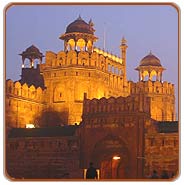
DELHI, the capital of kingdoms and empires is now a sprawling metropolis
with a fascinating blend of the past and the present. It is a perfect introduction
to the composite culture of an ancient land. A window to the kaleidoscope -
that is India.
Overnight will be at Delhi.
Day 02: Delhi - Jaipur
By Road 260 km in 6 hr
Proceed to Jaipur after breakfast.
JAIPUR - The origins of the beautiful city of Jaipur can be traced back
to the eighteenth century, during the reign of Jai Singh II who ascended the
Amber throne in 1699. Jaipur today, epitomizes the spirit of Rajputana. In-spite
of growing into a bustling metropolis, it still retains its character and history
- A beautiful fusion of the yesteryears and modernity. Jaipur is popularly known
as the Pink City because of the extensive use of the locally abundant pink plastered
stone, painted so in honor of the visit of the royal consort of Queen Victoria.
Jaipur thrills the soul with its massive forts, magnificent palaces, exquisite
temples and lush gardens. Start sightseeing of the city.
CITY PALACE - A delightful blend of Mughal and traditional Rajasthani
architecture, the City Palace sprawls over one-seventh of the area in the walled
city. It houses the Chandra Mahal, Shri Govind Dev Temple and the City Palace
Museum.
JANTAR MANTAR - This is the largest and the best preserved of the five
observatories built by Jai Singh II in different parts of the country. This
observatory consisting of outsized astronomical instruments is still in use.
HAWA MAHAL - The ornamental facade of this "Palace of Winds"
is a prominent landmark in Jaipur. It is a five-storey structure of sandstone
plastered pink encrusted with fine trelliswork and elaborate balconies. The
palace has 953 niches and windows. Built in 1799 by Pratap Singh, the Mahal
was a royal grandstand for the palace women.
Relax in the evening or visit the markets. Overnight will be at Jaipur.
Day 03: Jaipur - Ranthambore
By Road 180 km in 3 hr
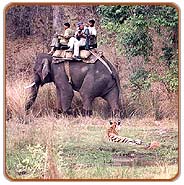
Proceed for a morning excursion to Amber Fort after breakfast. Elephant ride
ascent to the fort.
AMBER FORT PALACE - Amber is the classic romantic Rajasthani fort palace.
Its construction was started by Man Singh I in 1592, and completed by his descendent
Jai Singh I. Its forbidding exterior belies an inner paradise where a beautiful
fusion of Mughal and Hindu styles finds its ultimate expression. Transfer to
the station for train to SAWAI MADHOPUR after breakfast.
Drive to Ranthambhore. Reach and transfer to the resort. Evening free at the
resort and you can relax or watch some slides on the tiger.
Ranthambhore Tiger Reserve, at the junction of the Aravalis and the Vindhyas,
is a unique example of natural and historical richness, standing out conspicuously
in the vast, arid and denuded tract of eastern Rajasthan, barely 14 kilometers
from Sawai Madhopur.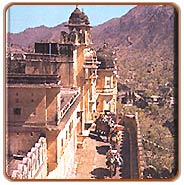 Get in tune with nature for a luxury holiday in the heart of the jungle.
It spreads over a highly undulating topography varying from gentle to steep
slopes; from flat topped hills of the Vindhyas to the conical hillocks and sharp
ridges of the Aravalis, from wide and flat valleys to narrow rocky gorges. An
important geological feature the 'Great Boundary Fault' where the Vindhya plateaus
meet the Aravali hill ranges, meanders through the Reserve. The National Park
is bound by the rivers Chambal in the south and Banas in the north.
Ranthambhore forest is of tropical dry deciduous type, further classified as
Dhok climax forest because of the predominance of Dhok (Anogeissus pendulla)
found nearly everywhere. Dhok is an extremely hardy tree, capable of withstanding
prolonged droughts. The leaves of this tree are good fodder and they are browsed
by herbivores, and form a significant part of their diet. Even the dry, fallen
leaves, eaten by them, are rich source of nutrition.
Palas or Cheela or the Flame of the Forest (Butea monosperms) blooms magnificently
around mid-April. During the period, Kachida and Anatpura provide an amazing
view, like a forest on fire. Around Kamaldhar massive Gum trees (Sterculia urens)
with smooth white trunk stand out conspicuously. Similarly, Gurjan (Lannea coromandelica)
with greyish trunks at the banks of the lakes and soft wood Salar (Boswellia
serrata) dotted atop hills are noticeable.
Fruits of Ber (Zizyphus spp.) and 'crocodile bark' Tendu (Diospuyros melanoxylon)
are highly relished by Sloth Bears. The lakes abound with aquatic vegetation
including duck weeds, lilies and lotus. A haven for a multitude of wild animals,
the Park boasts of playing host to tigers, leopards, the elusive caracals, hyenas,
sloth bears, wild boars, crocodiles and so on. Besides, there are over 300 species
of birds, from the majestic Crested Serpent Eagle to the exotic Golden Oriole.
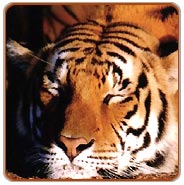
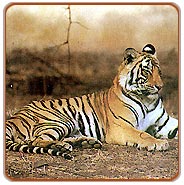
Tiger, at the apex of the food chain, lord over the kingdom in a subtle way.
Solitary by nature, it operates in stealth. Therefore tiger sightings, frequent
as they are, are always a matter of chance. However, even evidences of tiger's
activities are very exciting.
The other kinds of cats found in Ranthambhore are Leopard (Panthera pardus),
Caracal (Felis caracal), Leopard Cat (Felis bengalensis), Fishing Cat (Felis
viverrina) and the Jungle Cat (Felis chaus). Besides the big cats, the other
large predators found in Ranthambhore include Sloth Bear, Striped Hyena, Wolf,
Wild dog (or Dhole), Jackal, Indian Fox, Palm Civet, Small Indian Civet, Common
Indian Mongoose, Small Indian Mongoose, Ratel (or Honey Badger), Marsh Crocodile
and the Indian Python. There are two species of Antlers, namely the Spotted
Deer (or Chital) and the Sambhar Deer, and, two kinds of Antelopes, namely the
Indian Gazelle (or Chinkara) and the Bluebull (or Neelgai). Overnight will be
at resort.
Day 04: Ranthambore
 Breakfast
will be at the lodge.
Breakfast
will be at the lodge.
Proceed for full day game viewing inside the jungle. (Two safaris with lunch
break in-between)
Overnight will be at the resort.
Day 05: Ranthambore
Breakfast will be at the lodge.
Proceed for full day game viewing inside the jungle. (Two safaris with lunch
break in-between) Overnight will be at the resort.
Day 06: Ranthambore - Agra
By Road 220 km in 6 hr
Proceed to Agra after breakfast.
AGRA: Two great Mughal monarchs, Akbar and Shah Jahan, transformed the
little village of Agra into a befitting second capital of the Mughal Empire
- giving it the name Dar-ul-Khilafat {seat of the Emperor}. Today a visitor
to Agra is caught up in a world of contrasting edifices, of red sandstone and
white marble, narrow galleys and quaint buggies, and that irresistible charm
that this favorite city of the Mughals still retains. It is not surprising,
that modern Agra still reflects its Mughal heritage most conspicuously. A walk
down the narrow bustling streets of the city will introduce the visitor to the
wafting aroma of Mughlai cuisine.
Reach Agra. Check in at hotel. Overnight will be at Agra.
Day 07: Agra - Umaria (Bandavgarh)
By Overnight train
Proceed to visit Taj after breakfast. Enjoy battery van ride to the Taj.
TAJ MAHAL: Little needs to be said about this architectural wonder which
is always the soul raison-de-etre for every tourist's visit to Agra. Built by
Shah Jahan, the Taj is a white marble memorial to his beautiful wife Mumtaz
Mahal. This monument took 22 years to be completed and was designed, and planned
by Persian architect Ustad Isa. Apart from its stunning design balance and perfect
symmetry, the Taj is also noted particularly for its elegant domes, intricately
carved screens and some of the best inlay work ever seen.
Proceed for sightseeing to the AGRA FORT - Built by the famed Mughal emperor
Akbar in 1565 AD, the fort is predominantly of red sandstone. Ensconced within
is the picture perfect Pearl Mosque, which is a major tourist attraction.
Visit Itmadullah's Tomb built by Empress NOOR JEHAN in memory of her father
(The interiors of which are considered better than the Taj).
 You
will be transferred to station for train to UMARIA. Overnight will be on train.
You
will be transferred to station for train to UMARIA. Overnight will be on train.
Day 08: Arrive at Bandavgarh
Reach UMARIA and transfer to Bandavgarh. Reach and enjoy breakfast.
Bandavgarh is a new National Park with a very long history. Set among the Vindhya
hills of Madhya Pradesh with an area of 168sq miles (437sq km) it contains a
wide variety of habitats and a high density of game, including a large number
of Tigers. This is also the White tiger country. These have been found in the
old state of Rewa for Many years. Maharaja Martand Singh captured the last known
in 1951. This white Tiger, Mohun is now stuffed and on display in the Palace
of Maharaja of Rewa. Prior to becoming a National Park, the forests around Bandavgarh
had long been maintained as a Shikargah, or game preserve of the Maharaja of
Rewa. The Maharaja and his guests carried out hunting - otherwise the wildlife
was well protected. It was considered a good omen for Maharaja of Rewa to shoot
109 tigers. His Highness Maharaja Venkat Raman Singh shot 111 Tigers by 1914.
There are 32 hills in this part of the park, which has a large natural fort
at its center. The fort's cliffs are 2625 feet (800 meters) high, 1000 feet
(300 meters) above the surrounding countryside. Winter temperatures (Nov-mid-February)
vary from almost freezing at night to around 68 degree Fahrenheit in the daytime.
Summer nights are also cooler than the daytime temperatures, which rise to 104
degree Fahrenheit. This park is closed during the breeding season, which coincides
with the monsoon (July-October). Rainfall in the park averages 50 inches (120cm)
per year.
Bandavgarh has been a center of human activity and settlement for over 2000
years, and there are references to it in the ancient books, the Narad-Panch
Ratra and the Shiva Purana. Legend has it that Lord Rama, hero of the Hindu
epic, the Ramayana, stopped at Bandavgarh on his way back to his homeland after
defeating the demon King Ravana of Lanka. Two monkey architects, who had engineered
a bridge between the isle of Lanka and the mainland, are said to have built
Bandavgarh's Fort. Later Rama handed it over to his brother Lakshmana who became
known as Bandavdhish "The Lord of the Fort". Lakshmana is the particular
God of the fort and is regularly worshipped in a temple there.
The oldest sign of habitation in the park are caves dug into the sandstone to
the north of the fort. Several contain Brahmi inscriptions dating from the 1st
century BC. Various dynasties have ruled the fort, for example, the Maghas from
the 1st century AD, the Vakatakas from the 3rd century AD, from that time onwards
Bandavgarh was ruled by a succession of dynasties including the Chandela Kings
of Bundelkhand who built the famous temples at Khajuraho. The Baghel Kings,
the direct ancestors of the present Royal family of Rewa, established their
dynasty at Bandavgarh in the 12th century. It remained their capital till 1617
when the center of court life moved to Rewa, 75 miles (120Kms) to the north.
Without royal patronage Bandavgarh became more and more deserted until forest
overran the area and it became the royal hunting reserve.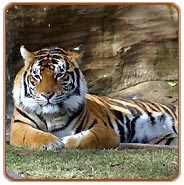 This helped to preserve the forest and its wildlife, although the Maharajas
made full use of their rights. Each set out to kill the auspicious number of
109 Tigers.
This helped to preserve the forest and its wildlife, although the Maharajas
made full use of their rights. Each set out to kill the auspicious number of
109 Tigers.
At independence Bandavgarh remained the private property of the Maharaja until
he gave it to the state for the formation of the National Park in 1968. After
the park was created poaching was brought under control and the number of animals
rose dramatically. Small dams and water holes were built to solve the problem
of water shortage. Grazing by local cattle was stopped and the village within
the park boundaries was relocated. The Tigers in particular prospered and the
1986 extension provided much needed forest to accommodate them.
Bandavgarh is justifiably famous for its Tigers, but it has a wide range of
other game. The undergrowth is not as dense as in some northern terai forests,
but the best time to see the park inhabitants is still the summer months when
water becomes scarce and the undergrowth dies back.
Proceed for full day game viewing inside the jungle. (Two safaris with lunch
break in-between)
Overnight will be in the lodge.
Day 09: Bandavgarh
Breakfast will be at the resort.
Proceed for full day game viewing inside the jungle. (Two safaris with lunch
break in-between)
Overnight will be at the resort.
Day 10: Bandavgarh
Breakfast will be in the lodge.
Proceed for full day game viewing inside the jungle. (Two safaris with lunch
break in-between)
Trip to the Bandavgarh Fort: The oldest fort in India - considered to
be more than 2500 years. One-hour trek up the fort is worth the effort. The
charm of this trek lies in discovering these monuments in the jungle, unspoiled
and unexplored. Some of the statues lie off the main path and so it is best
to take a guide. Apart from the avatars, well worth seeing are three small temples
of around the 12th century. These temples are deserted but the fort is still
used as a place of worship. Kabir Das, the celebrated 16th century saint, once
lived and preached here. The natural ramparts of the fort give breathtaking
view of the surrounding countryside. The fort still belongs to the Maharaja
of Rewa and permission is required to visit it. However permission is available
locally and no trip to Bandhavgarh is complete without making an effort to climb
up the fort. The staff of the resort carries your lunch while you are busy negotiating
the trek to the fort.
Overnight will be at the resort.
Day 11: Bandavgarh - Kanha
By Road 255 km in 6 hr
After breakfast drive to Kanha.
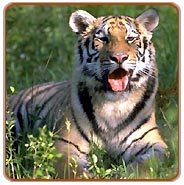
This is the place that has been described by RUDYARD KIPLING in his great book
"The Jungle Book". Located in the Mandla district of Madhya Pradesh,
Kanha National Park is a tiger reserve that extends over an area of over 940
square km. A horseshoe shaped valley bounded by the spurs of the Mekal presents
an interesting topography. Steep rocky escarpments along the edges offer breathtaking
views of the valley. Realizing the danger on the Tiger population in the country,
the Government started the "Project Tiger" at Kanha and in 1974 the
area was declared a Tiger reserve. The park is also the habitat of the high
ground Barasingha.
In 1930s, the Kanha area was divided into two sanctuaries - Hallon and Banjar
of 250kms to 300kms each. Though one of these was subsequently disbanded .The
area remained a protected one until 1947. Depletion of the tiger population
in the year that followed led to the area being made an absolute sanctuary in
1952.
Patient watching should reward the visitor, with a sight of Indian Fox, Sloth
bear, Striped hyena, Jungle cut, Lepord, Mouse Deer, Chausingha or four horned
antelope, Nilgai, Ratel and Porcupine Kanha has some 200 species of birds. Watchers
should station themselves in the hills, where the mixed and bamboo forests harbour
many species and in the grassy forest clearings. Water birds can be seen near
the park's many rivulets and at Sarvantal, a pool that is frequented by water
birds and the area in front of the museum.
Excursion to Kawardha just east of the Maikala Range (up to 1100m) to the south
east of Kanha National Park, Kawardha is a small town in Chhattisgarh (34 forts)
region of M.P. In this remote area Maharaja Viswaraj Singh has recently opened
his palace to visitors. It provides a delightfully quite unspoiled contrast
with India's big cities and with the much busier tourist circuit of Rajasthan's
'palace circuit'. This town is in the center of the Baiga tribe, who live in
forest surrounding the town, and these are several eleventh century temples
in the immediate region.
Reach in the afternoon and relax at the resort.
Overnight will be at the Kanha Resort.
Day 12: Kanha
Breakfast will be at the resort.
Proceed for full day game viewing inside the jungle. (Two safaris with lunch
break in-between)
Overnight will be at the resort.
Day 13: Kanha - Nagpur
By Road 240 km in 5 hr
Proceed for the morning safari into forest.
Proceed to NAGPUR after lunch. Reach and relax at the hotel. Overnight will
be at Nagpur.
Day 14: Nagpur - Delhi
By Air
Flight Number : CD 7470/7469
Aircraft : Boeing 737
Departure : 0900/1010/1015 (Depending on the day)
Stopover : Nil
Arrival : 1025/1135/1140
Breakfast will be at hotel.
Transfer to airport for flight to Delhi. Spend day relaxing at the hotel or
spending time at local markets. Overnight will be at Delhi.
Day 15: Delhi - Home
Proceed for a day tour of Delhi after breakfast.
OLD DELHI - A sightseeing tour of Old Delhi would entail visiting the
Raj Ghat - the memorial site where Mahatma Gandhi was cremated; Jama Masjid
- the largest mosque in India and the Red Fort - once the most opulent fort
and palace of the Moghul Empire.
Take a cycle rickshaw ride from Jama Masjid to Chandni Chowk.
NEW DELHI - An extensive sightseeing tour of New Delhi would include
a visit to the Humayun's Tomb, the Qutub Minar, a drive along the ceremonial
avenue - Rajpath, past the imposing India Gate, Parliament House and the President's
Residence and would end with a drive through the Diplomatic Enclave.
Transfer to airport in time for flight home.